Women's Hair Health • November 11, 2026
Perimenopause Hair Changes: When Your Texture Shifts & Thinning Begins
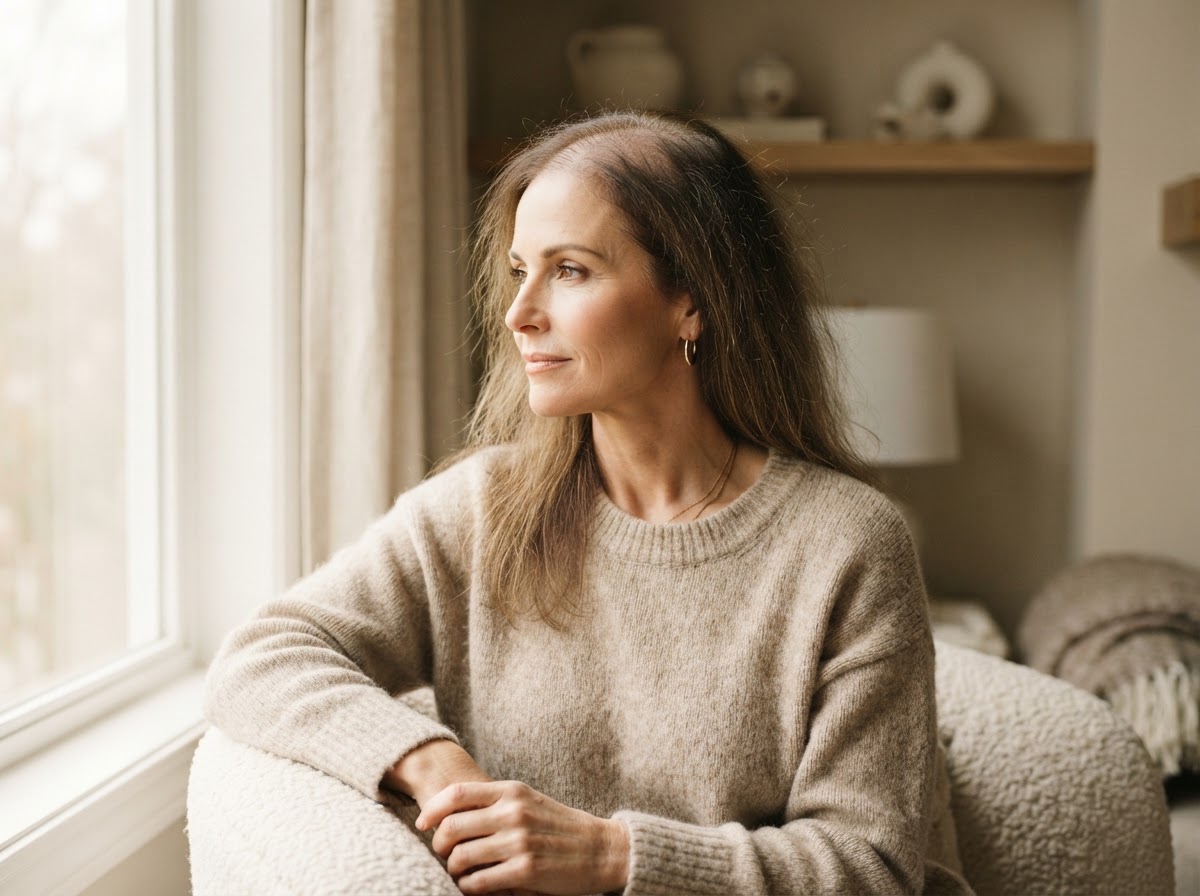
"My hair used to be straight and thick. Now it's wavy, fine, and falling out — and nobody warned me this was part of perimenopause."
If that sounds familiar, you are far from alone. Perimenopause — the years leading up to menopause — can begin in your late 30s or early 40s, often a decade before periods actually stop. And one of the most surprising, least talked about changes happens right on top of your head: your hair.
Women across St. Petersburg, Clearwater, and Tampa Bay come to Luxe Hair Concierge every week saying the same thing — "My hair doesn't behave like it used to." It may have gone from straight to wavy. It may feel finer, dryer, more fragile. It may be thinning at the crown or part line. This guide walks through exactly what's happening, why, and the gentle, in-home options available to help you feel like yourself again.
Why Perimenopause Changes Your Hair
Your hair follicles are deeply sensitive to hormones. During perimenopause, estrogen and progesterone levels begin to decline — often unevenly — while androgens (male hormones present in all women) stay relatively stable. That shifting ratio is the root of most perimenopause hair changes.
- Estrogen drop: Estrogen extends the growth (anagen) phase of hair. As it falls, hair spends less time growing and more time resting and shedding.
- Progesterone drop: Progesterone naturally blocks androgen receptors. With less of it around, androgens can shrink follicles and shorten the growth cycle.
- Thyroid fluctuations: Perimenopause often overlaps with thyroid changes, which independently cause thinning and texture shifts.
- Stress & cortisol: Hot flashes, sleep disruption, and the emotional toll all raise cortisol, which pushes more follicles into shedding.
When Straight Hair Turns Wavy — Or Wavy Hair Turns Frizzy
The hormone-driven change that catches women most off guard is a complete change in hair texture. Hair that was stick-straight for decades can suddenly grow in wavy or curly. Hair that was loosely wavy can become tightly coiled, frizzy, or coarse. Here's why:
The shape of each strand is determined by the follicle, and follicles are hormone-responsive. As estrogen and progesterone shift, they alter how the follicle shapes the hair shaft — changing its curve, its diameter, and the way oils travel down the strand. The result: new growth that simply doesn't match the hair you've known your whole life.
On top of that, perimenopause also changes your scalp's oil production. Sebum drops, leaving hair drier and more porous, which makes new waves or curls look frizzy and undefined rather than polished. Many women describe their hair as suddenly "unruly" or "not mine."
Thinning: The Part Line & the Crown
Alongside the texture change comes thinning — and this is where the androgen piece really shows up. As estrogen falls and androgens gain relative influence, follicles along the part line and crown can miniaturize: each hair grows back finer, shorter, and lighter, until the scalp starts to show through.
This is female pattern hair loss, and in perimenopause it often shows up as:
- A wider, more see-through part line
- Less volume at the crown, even with a fresh cut
- A ponytail that feels noticeably thinner
- Short, wispy "baby hairs" that never seem to grow long
- More hair in the shower drain and the brush
It's worth naming: this is not your fault, and it's not a sign you did something wrong. It is a physiological shift, and there are real, gentle solutions for it.
What Actually Helps: Texture & Dryness
When your texture changes, the old routine stops working. The products and tools that smoothed straight hair can now fight your natural new pattern. A few things genuinely help:
Hydrate, Don't Strip
Switch to sulfate-free, moisture-rich washes. Your scalp is producing less oil now — harsh cleansers make dryness and frizz worse.
Work With the Wave
If new texture is coming in, curl creams and air-drying often define it better than fighting it flat with heat.
Deep Treatments
Weekly moisture or bond treatments help fragile, porous strands stay elastic instead of snapping off.
Rethink the Cut
A shape built for your hair's new behavior — not its old one — can restore volume and make thinning far less obvious.
What Actually Helps: Thinning & Volume Loss
For thinning, the conversation is different. Topical care can protect and support what you have, but when density has visibly dropped, many women want a real restoration solution — not just a better blowout.
That's where mesh and meshless integration hair systems come in. Trained in the Elevate method, Ceara designs custom, non-surgical systems for women whose hair has thinned through perimenopause, menopause, thyroid changes, and other hormonal shifts. These gentle systems restore density at the crown and part line without glue, shaving, or tension on already-fragile hair — and the entire process happens privately in your home.
If you're also navigating the emotional side of this — the loss of familiarity with your own hair — you're not alone in that either. A consultation is a safe place to talk it through, with no pressure and no judgment.
"Cotton Candy Hair" — What It Means & What You Can Do
You may have heard the term "cotton candy hair" — it's the phrase women use to describe that fine, wispy, fluffy texture that shows up during perimenopause. The strands feel weightless and undefined, almost like the spun sugar at a fair: soft to the touch, but lacking body, shine, or hold. It happens because the new growth coming in is finer in diameter and the scalp is producing less sebum to coat each strand. The result is hair that looks and feels puffy but fragile.
The good news: cotton candy hair responds well to a few simple, consistent changes. You don't need a complicated routine — just a targeted one.
Diet & Nutrition
Protein at every meal supports keratin production. Add omega-3s (salmon, walnuts, flaxseed) to calm scalp inflammation. Iron-rich foods (spinach, lentils, lean red meat) and vitamin C (bell peppers, citrus) help follicles hold onto hair longer. A daily multivitamin with biotin and zinc fills common perimenopause gaps.
Targeted Supplements
Biotin (2,500 mcg) strengthens the hair shaft. Saw palmetto may gently reduce androgen-driven shedding. Collagen peptides improve strand elasticity. Vitamin D3 (if low) supports follicle cycling. Always run new supplements by your doctor first — they can interact with other meds.
Ketoconazole Shampoo & DHT
One of the simplest, most researched options for androgen-driven thinning is a 1% ketoconazole shampoo used 2–3 times a week. Ketoconazole is an antifungal that also mildly blocks DHT at the scalp level — the hormone responsible for shrinking follicles along the part line and crown. It's available over the counter, gentle enough for daily-adjacent use, and pairs well with any of the integration systems above. Think of it as a low-effort, high-coverage layer of protection while you and your stylist work on the bigger picture.
None of these are overnight fixes — hair grows roughly half an inch per month, so consistency matters more than intensity. Pick two or three changes you can stick with, give them three months, and then reassess. Your hair — and your confidence — are worth the patience.
Talk to Your Doctor, Too
Sudden or rapid shedding deserves a medical check. Ask your provider to run a thyroid panel, check iron and ferritin, vitamin D, and hormones. Hair loss can be a clue that something upstream needs support — and the sooner it's addressed, the better your hair responds.
Why Women Choose In-Home Care for This
Perimenopause hair loss is deeply personal. Sitting in a bright, mirrored salon surrounded by other clients can feel exposing when you're already unsure about your hair. That's exactly why so many Tampa Bay women choose Luxe Hair Concierge: the consultation, the styling, and the installation all happen one-on-one, in the privacy of your own home.
When you can't make it to the salon, LUXE comes to you — with the full luxury setup, on your schedule, and entirely on your terms.
Let's Navigate This Together
Whether your texture has changed, your hair is thinning, or you just want to understand what's happening — book a private, $75 consultation in St. Petersburg, Clearwater, or Tampa Bay.


